An Interview with Translator Kevin Wang
Part 2 of an interview with Kevin Wang, who talks about making a life in Taiwan, code-switching, translating Du Fu, and being Chinese American here; plus, little updates


Dear all,
Hello! We’re thinking of all of you. We’re back this week with an interview with Kevin Wang, who was born in China and migrated to the U.S. when he was nine years old. It’s been four years since he moved to Taiwan. He talks about his journey to becoming a translator & writer, what it’s like being Chinese American in Taiwan, and how he’s made a life here.
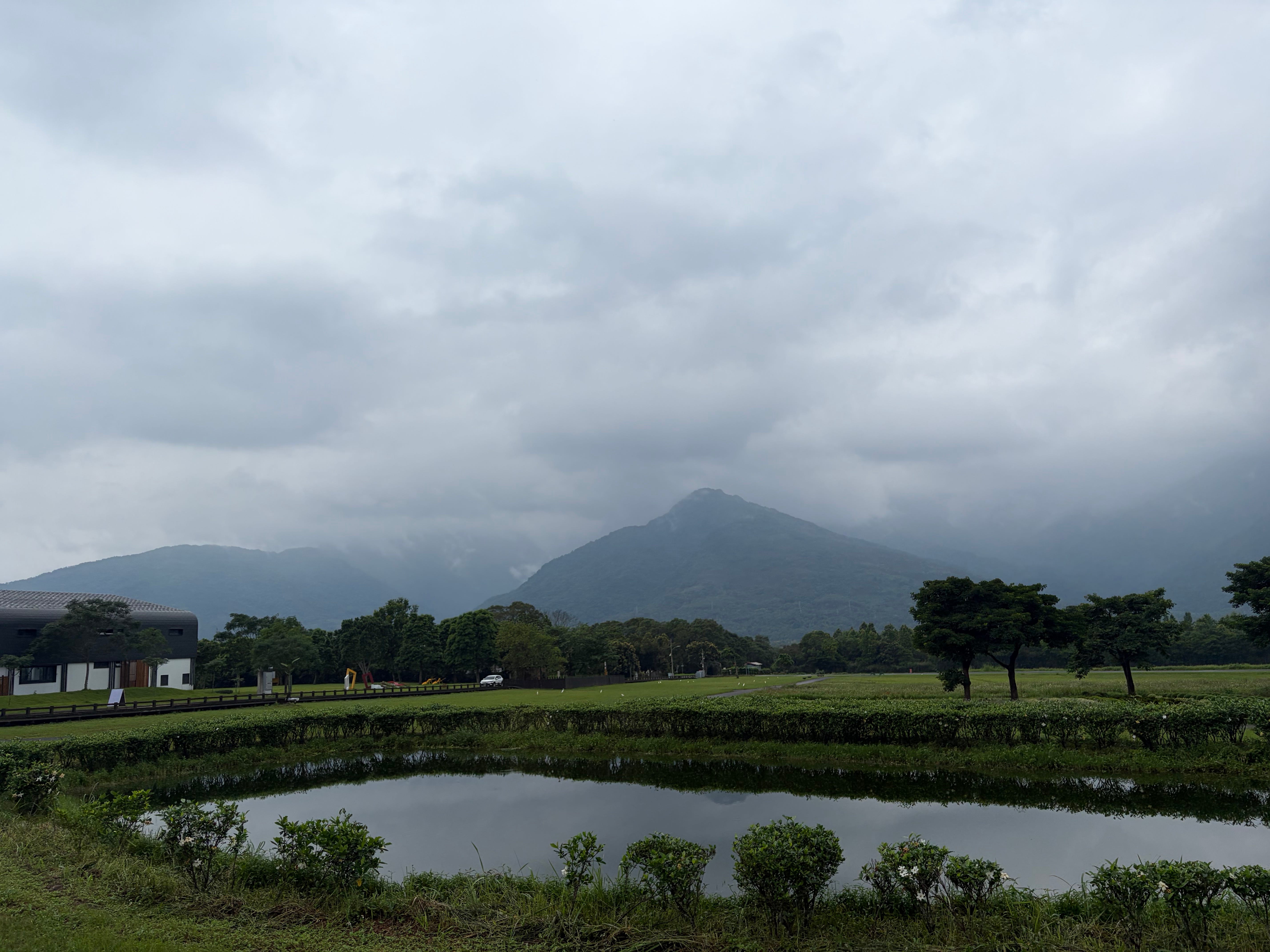
A brief update: a couple of weekends ago, we tagged along on a university trip to Guangfu Township, Hualien led by Professor Gina Tsai, herself a Hualien native. She and her amazing assistant Casper brought over 40 college students from National Chengchi University. Together we went to a farm that was ground zero of last year’s floods. She told us said the farm would not exist without the 100,000 people in Taiwan who spontaneously traveled across the country to shovel mud. (These were the “shovel superheroes” of Taiwan.) We also visited an indigenous village, where we learned how to craft eco-containers from paper mulberry tree. We’ve been wanting to sit down and process everything, but haven’t had a chance to catch our breath!
That trip to the eastern coast dovetailed with a visit from historian Julia Thomas, whose humility and deeply curious sensibility inspired us. An intellectual historian of Japan and the Anthropocene, she grew up in the coal country of southwest Virginia. She said in the Q & A that the most important things in the coming disasters are friendship, social bonds, and things like community festivals. This might sound idealistic, but she rejected utopianism as her frame or an aspiration. She cited research by scholars such as Daniel Aldrich, who studied survival rates after the tsunami and found that communities with stronger social ties had lower mortality rates. We could have listened to her talk for days!
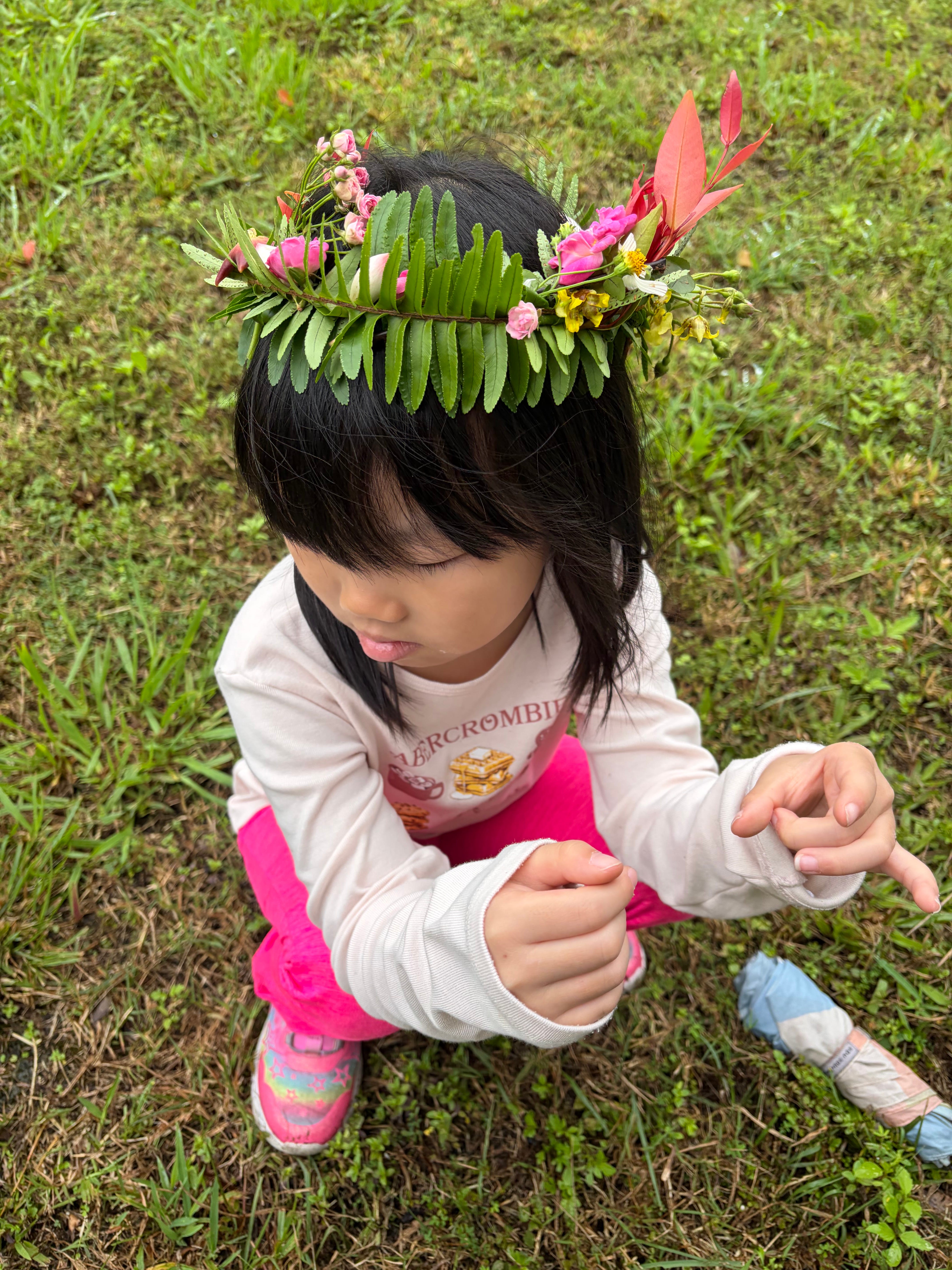
We've been sitting with all of this, thinking too about what kind of schooling no-longer-baby-P. will have. (Almost seven! Sob sob.) We want to shed so much of it—the competition and achievement that characterizes elite education—and give her something rooted: an education that teaches friendship, collaboration, and creativity in the Anthropocene. People ask us, "But don't you want her to go to the schools you went to?" No. We made great friendships and cherish the liberal arts—we believe deeply in Great Books programs, in the humanities—but these can happen anywhere in the world, in any context, in any place. We can bring them to life in rural areas, in prisons, in our own neighborhoods. We’re not trying to to preach to other parents what to do in a fiercely competitive world (and we know we’re lucky to live in a country with universal healthcare), but the past few weeks have pushed us to think even more deeply about limiting the extent to which we reproduce social privilege. How to create a daily life grounded in relationships and values? This is the question we’re always chasing after, though falling short.
You can check out Michelle’s piece about Taiwan’s determination to preserve its sovereignty in The Dial, as well as an interview. This essay will appear in a book of essays from The New Press (June 2026), How We See It: The World Looks at America In the Age of Trump. The editors at The Dial were meticulous in their fact-checking and review. We love The Dial; it’s one of the few English-language outlets that looks beyond the Anglosphere, reporting and translating work that would otherwise never exist in English. (Along that vein, read this terrific piece from Mauritius on climate change.) Albert is also glad to share that Uncanny Beliefs: Superstition in Modern Chinese History, co-edited with the wonderful Emily Baum, just came out with the Harvard Asia Center.
A few events coming up. Hilda Hoy is speaking at Bookman on June 6th (Register here, but you can also show up!) She’ll be talking about her perfect little book Mother Tongue, published by Wind & Bones. Bonny Ling is speaking at New Bloom/Daybreak this Sunday evening at 7 P.M. about migrant labor and ethical recruitment. On Tuesday, May 19th (tomorrow) at 7 P.M. the Taiwan Innocence Project is sharing its experiences from recent travels to the U.S. (online, in Mandarin).
Interview with Kevin Wang, Part 2
Today we’re delighted to share an interview with Kevin Wang, translator of the Taiwanese writer Terao Tetsuya’s Spent Bullets 《子彈是餘生》. Terao is one of the most exciting voices in contemporary Taiwanese fiction—winner of the Lin Rong-san Literary Award and twice selected for the Chiu Ko Annual Fiction Anthology. For those wondering about the author’s Japanese-sounding name, Terao is his pen name, and in real life he’s known as Tsao Cheng-hao 曹盛濠.
The first part explored Spent Bullets and Terao’s biography. Today’s interview explores Kevin’s personal background, his journey from China to the U.S. to Taiwan, and how he came to be a translator and teacher. If you’ve ever met Kevin, you’ll be struck as we were by his charm, humor, gentle presence, and spirit of openness and dialogue.
We conducted this interview at the tail end of Lunar New Year at our apartment. Our orange tabby cat sat on his lap for a good portion of it. You can order Spent Bullets here in English, and here in Mandarin.
Albert: Let’s pivot to Kevin! Let’s talk about you. You’ve been in Taiwan for four years now. How did moving to Taiwan happen?
Kevin: I wanted to be in a democratic country where people also spoke Mandarin. I was drawn to all of Taiwan’s tensions. I’ve always been suspicious of nationalism of any kind, so I didn’t trust any of the narratives about Taiwan that I was being told, whether that’s from the news or my parents.
One Chinese claim is that there have been Chinese fishermen here since the Song Dynasty. The Western story is that it’s going to be invaded any day, like it’s a soccer ball being kicked between superpowers. I preferred to hear about Taiwan from Taiwanese friends, like Lin [King], who would describe a beautiful way of life and aspects of traditional culture that have been lost across the strait.
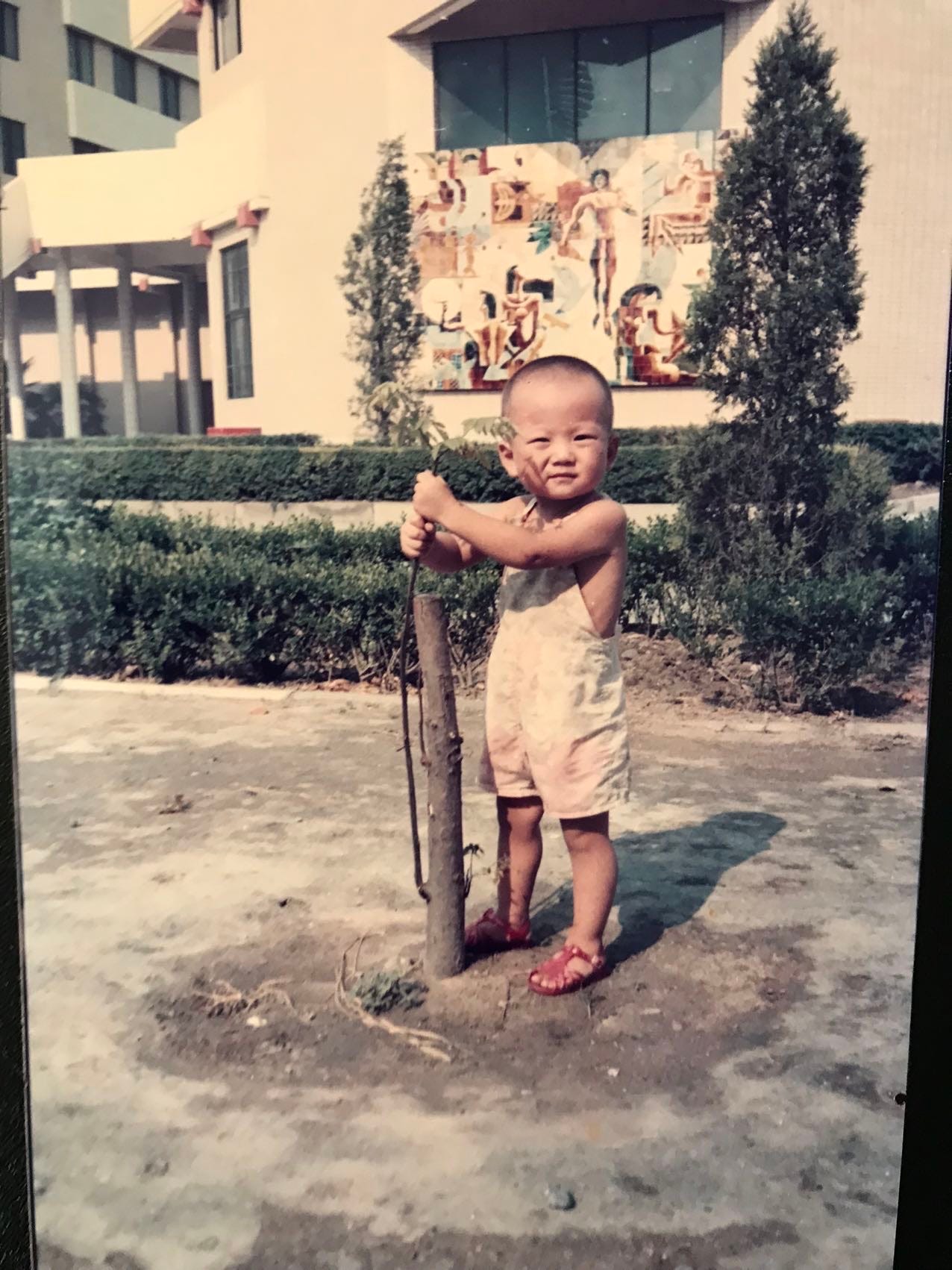
Albert: You were born and raised in China; up to fourth grade you’re in Henan, and then Xiamen. Then you migrated to the United States. What are your strongest memories from that time before you left?
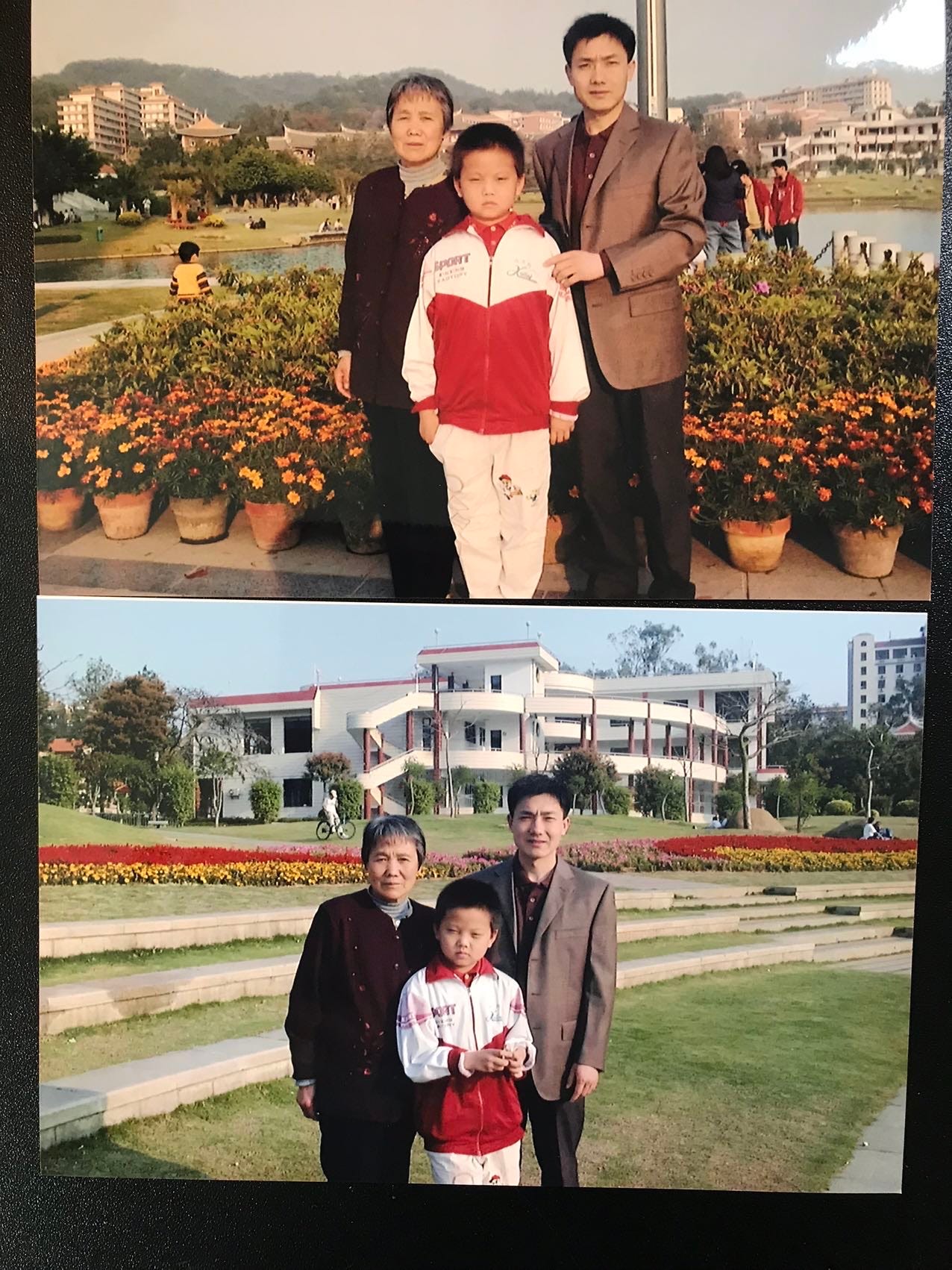
Kevin: I have memories of climbing on walls with other kids, and my grandmother waiting in the background. In Xiamen, I was suddenly a country bumpkin speaking a different dialect to the sophisticated kids.
Michelle: What did you know of Taiwan when you were growing up in China?
Kevin: I knew nothing of Taiwan for a long time. Chinese kids are taught that “台湾是祖国的宝岛。” (Taiwan is the Motherland’s Treasure Island). On the map, it’s just another province. My parents remember more about Taiwan from their school days. They knew songs like 阿里山的姑娘 ( Maiden of Alishan) , 外婆的澎湖灣 (Grandma’s Penghu Bay)。
Briefly, my grandmother would be worried about my father living in Xiamen, because what if the two sides start firing missiles at each other? I vaguely remember seeing a big sign on a Xiamen beach that faces toward Kinmen. It said that “one country, two systems unites China.” I didn’t know what that meant at the time. As a kid, I knew that “Taiwan” was something controversial—mentioning the idea of Taiwan or “liberating Taiwan” was a way to be funny and edgy and to call attention to yourself.
Albert: What’s it like being Chinese or Chinese American here? Have you encountered any discrimination?
Kevin: I think so. I get it—it’s the punching-up idea. The country with more than a billion people threatens to colonize you. I don’t take it personally and let it go. Though I’m not sure if that’s the right thing to do?
Michelle: Do people explicitly say something?
Kevin: In my first year living here, I’d sometimes hear people refer to mainland Chinese as 你們那邊的人 (”you guys on that side”). Which made me a bit anxious, to be grouped like that.
I do see people get defensive immediately when I say where I was born. I’ll be interrogated about my values. But really, there is not discrimination in any explicit verbal sense that I’ve experienced; people in Taiwan & China have been very civil and nice when I tell them where I’m from and live. The demonic discourse is just in places like Threads and Douyin. On the Taiwan side (which I see most on Threads), for me the most memorable discrimination toward Chinese is insults and revulsion toward Mainland usage and the Beijing accent. It hits a nerve of course because that is how people like my parents speak Chinese.
On the other hand, that online discourse is almost surreal, and I don’t believe it really reflects how most people think. Once again, I also tell myself not to take it personally; there is real anxiety that linguistic choices in Taiwan are becoming influenced by PRC media power, so the figure of the 支語警察 (Mainland China Usage Police) comes from being protective of self-determination. The risk is just with dehumanizing other people.
The tougher issue is more with paperwork because I was born in China; for example it makes applying for an ARC (alien resident certificate) or Gold Card more complicated and drawn out.
Michelle: I remember you telling me you took your dad around Taiwan. And you saw his views change.
Kevin: He saw the distinct way of life here and how that’s worth protecting. He had a piece of garbage that he carried around for miles. He really wanted to put it down, but he saw the civic discipline of not doing that, and he didn’t want to tarnish this. He also said an influx of Chinese people would make the housing prices exorbitantly high.
Michelle: How did you get to the U.S?
Kevin: My parents met at Henan University. They were in the foreign language department—my mother studying Japanese, my father studying Russian. I would follow my father in his academic movements while my mother went to grad school in the U.S. Then mom took me to the U.S. for a Western education. My dad joined later because the long distance was untenable.
Albert: From kindergarten until fourth grade you were just with your dad?
Kevin: Grandma did some caretaking while Dad was away for grad school. So they’re part of this eighties generation that saw a lot of opportunity in the U.S. They weren’t one of the persecuted people, they come from peasant families. My father wanted to be a doctor and an engineer, but he didn’t test into those subjects, so he had to choose between English and Russian, and Russian seemed more useful at the time. He studied Russian literature, so I’d have Russian children’s versions of those stories lying around.
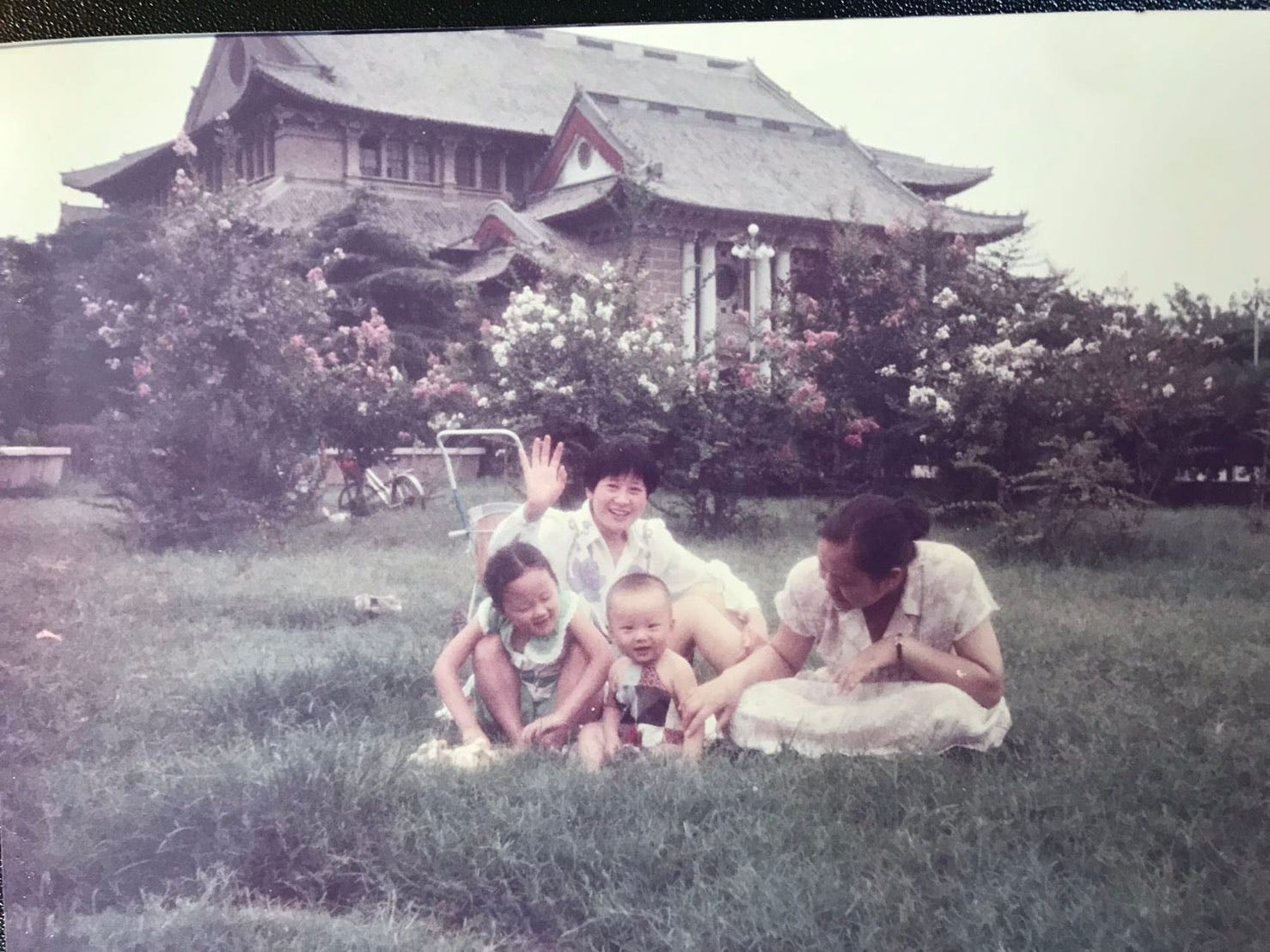
I was sensitive to words and to dialect — my mother speaks Jiyuan-hua. Jiyuan is the city in Henan where she’s from. And my father speaks the Henan dialect. My first words in Chinese were Henan dialect, that’s what I heard growing up. I was watching a fan spinning on the ceiling and saying, “轉哩轉哩.” Then they spoke Minnan in Xiamen. And then I was learning English in Virginia, where I moved to.
Maybe that’s where the sensitivity to how language sounds comes from. Or code-switching as a survival tactic, which is still a thing I do here now.
Michelle: How do you do it here?
Kevin: I turn on and off a Taiwanese Mandarin accent. I think because I’ve been here for four years and it’s long enough where I can be comfortable. At first, it felt fake for me to say “uh” for the number two. In China, you hear “ar,” like a pirate — the tongue is bent backwards. Like saying “s” instead of “sh” — I used to feel so uncomfortable doing that.
Michelle: But now it just comes out?
Kevin: Now it just comes out and it feels fine.
Michelle: Let’s talk about pedagogy. I’ve sat in on at least two of your lectures and thought they were brilliantly designed. And now you’re teaching 8 (!) courses at Taipei Tech. Were you aware of how you were being taught from a young age?
Kevin: My parents are both teachers. My dad’s name is Hank in English, and I recently learned from one of his former students that they used to call him Hanky — partly out of grievance that he grades them so harshly. “Hanky strikes again.” “Hanky’s killing me right now.” She still remembers his expression of disappointment.
The first time I had my own classroom was teaching at Summerbridge Hong Kong in 2015. In college I took a class where the professor wouldn’t show up unless we invited him — it was called “Citizen Studentship.” We all had to teach each other something. We designed the curriculum. I taught about translation, my friend Christian taught about Christianity, and then we would drink wine with the professor. It’s kind of a cop-out for the professor, but it’s awesome — open syllabus, everybody teaches something.
Michelle: What was your consciousness of Chinese and Taiwanese literature in college?
Kevin: First year I immediately loved my English classes the most. I took one class where there was a final project about rhetoric, and I chose to look at classical Chinese poetry. I think that’s where it all starts. It was so interesting to look at how these poems were translated in the past. And then I started trying the translation myself.
Michelle: I saw your review of the Du Fu poetry, the David Hinton translation.
Kevin: Wow, that is a niche thing. I didn’t know it’s up on the internet.
Michelle: Who’s your favorite Du Fu translator?
Kevin: Burton Watson. He has this perfect scholarly eye paired with a sense of lyricism.
Michelle: What’s your favorite Du Fu poem?
Kevin: It must be 國破山河在. “My country is broken.”
Michelle: My grandma made me memorize that one — that’s her favorite.
Here’s Kevin’s translation, also published at Asian American Writers Workshop:
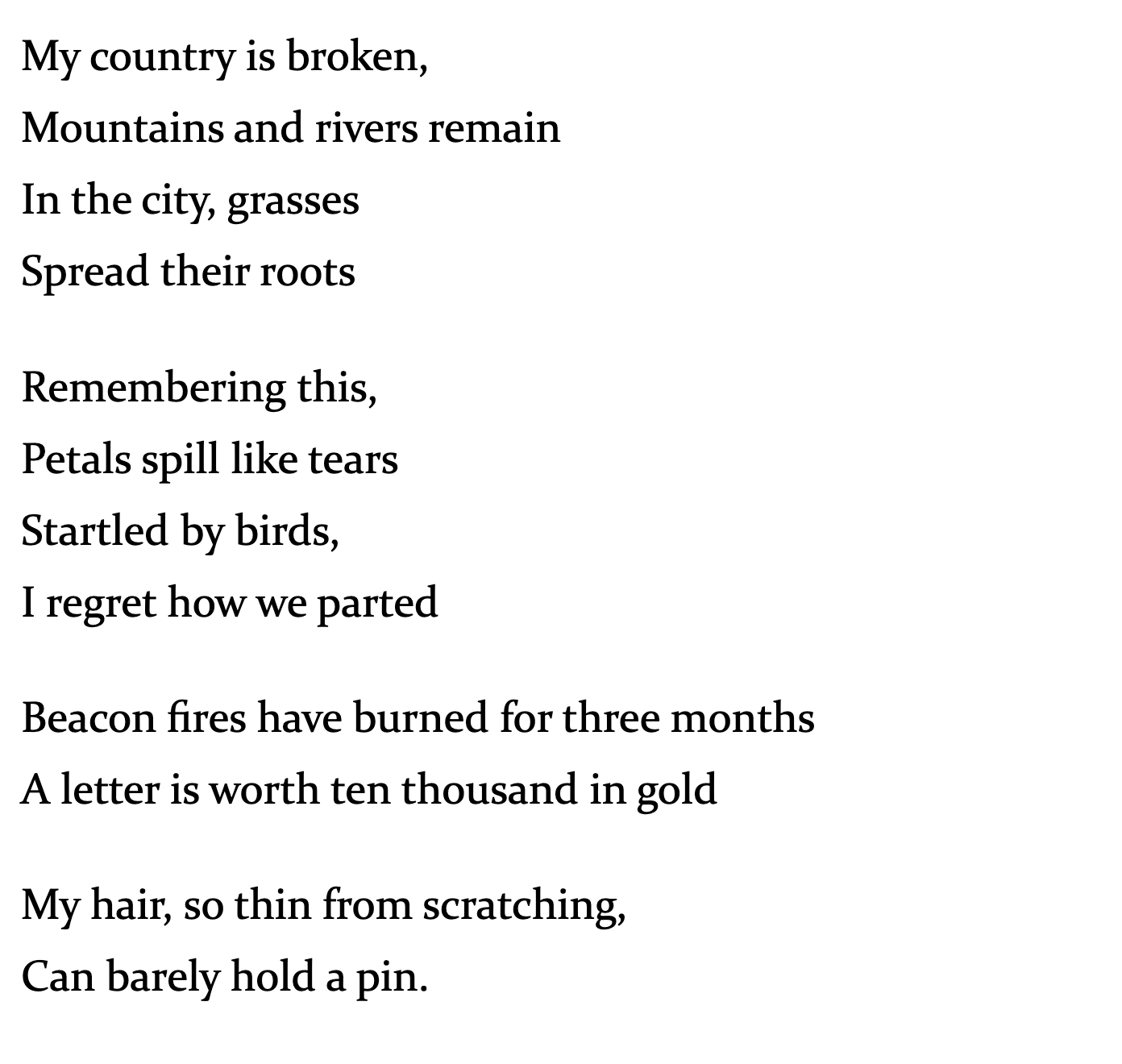
國破山河在,城春草木深。
感時花濺淚,恨別鳥驚心。
烽火連三月,家書抵萬金。
白頭搔更短,渾欲不勝簪。
Kevin: I think Du Fu was really an angry person. His poetry is pretty autobiographical — he’s witnessing a lot of injustice. Like piles of meat on one side of the gate and then frozen corpses on the other side. Or “my hut is leaking rainwater and my kids can’t fall asleep because it’s so damp.” He’s a war refugee for much of his life. He died on a boat.
I had no consciousness of Taiwanese literature in college. That came in grad school, when I first saw what a Taiwanese book looked like in a translation workshop. The text was running vertically, and I thought it was an experimental form. My classmate said “This is what all books look like.”
It wasn’t until 2019 that I started learning they don’t use pinyin here. Or learning about waishengren, benshengren, the Japanese occupation — all this because there was a contest to translate a Yang Shuang-zi excerpt from Season Where Flowers Bloom. I guess I used to think that democracy in Taiwan just sprang into existence in 1945.
Albert: So you did English and then what made you think, “I want to go do an MFA in translation”?
Kevin: Immediately after college I worked at a law firm as a paralegal. Bankruptcy law, big Chapter 11s. I had to tuck my shirt in and work until 10 PM. I saw what life was like for associates — junior levels trying to make mid-levels look good to senior levels. Everyone’s trying to pad their billable hours, time in six minute increments.
So I wanted to leave. I viewed grad school as a professionalization environment where, with a degree, I could teach the things I loved. I admire people who feel pain if they don’t write, but for me, it was more pragmatic. Translation was a part of it. I applied for nonfiction and translation.
Albert: So you moved to Virginia when you were in fourth grade?
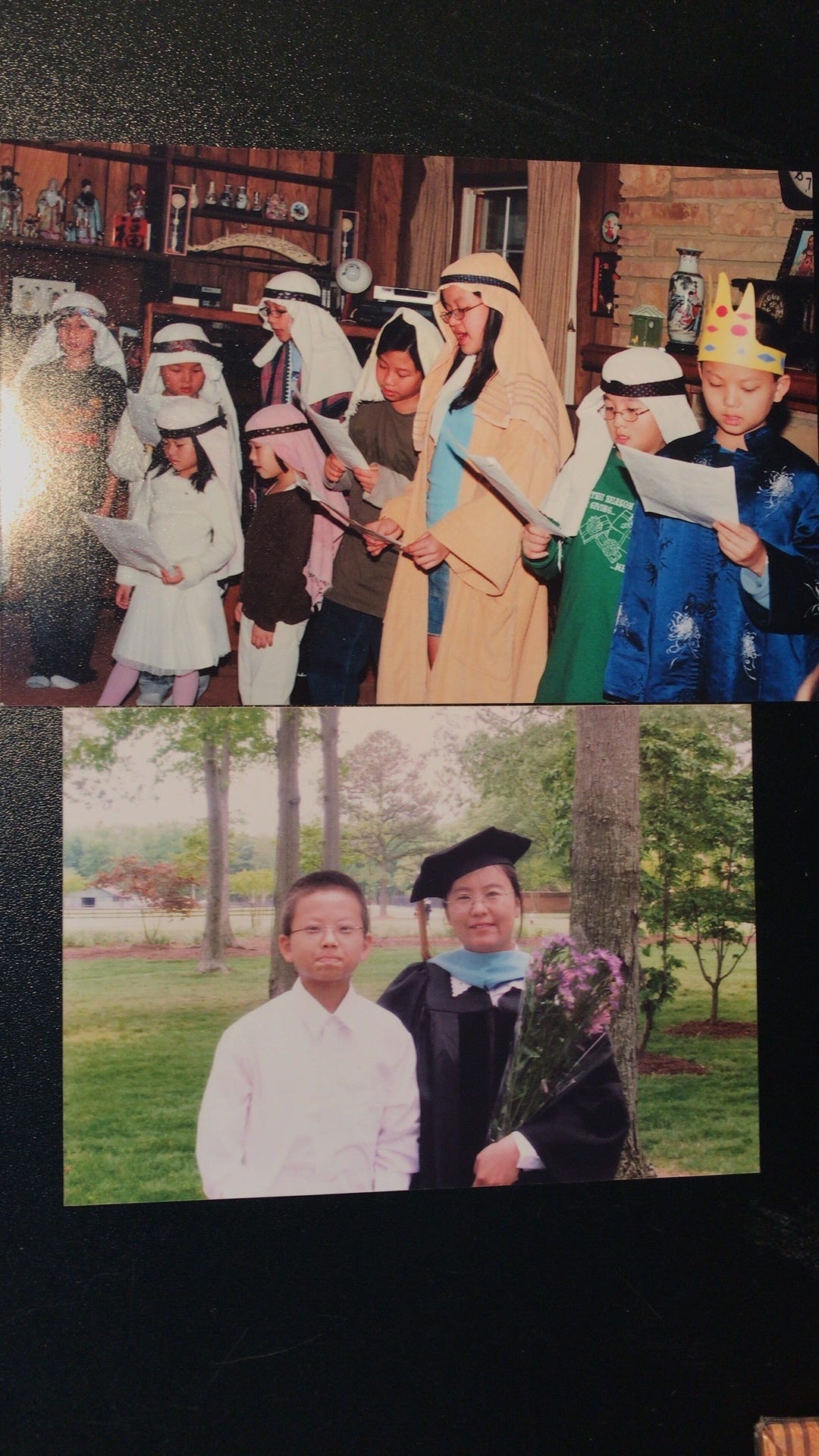
Kevin: I was in Virginia while my mom was doing her PhD there, in education. Virginia was amazing. Virginia Beach — she went to Regent University, in a very evangelical community. It’s the school founded by Pat Robertson. That’s my first encounter with America: evangelicals.
Albert: Did she grow up in a Christian family?
Kevin: Not at all. There was an exchange program with Lee University in Tennessee, so she went there for part of her master’s. And then she found this PhD program at Regent University. The motto of the school is “Christian Leadership to Change the World.” I would go on YouTube sometimes and see their videos — one is “Don’t Talk to the Police,” from the Regent Law School, with millions of views, saying the moment you start talking you’ve already lost.
Albert: That’s good advice.
Kevin: She probably became Christian in Tennessee — there’s a lot of peer pressure. And my dad converted after he moved here. I think they became more spiritual in the past few years because she had cancer, and then they’ve found great solidarity and comfort in the spiritual healing community. And now they’re checking in on me about my faith.
It was bladder cancer. It was sad to learn about the drugs that go into the chemo and what the side effects were. But I think she dealt with it with a lot of strength. The spiritual side really did help, I think.
It was an uncertain time. I was in Taiwan, but maybe I kept thinking I’d have to leave any moment to be with her. But then she kept getting better. This was two years ago.
Albert: So then Virginia until your mom finished the PhD, and then you moved to Massachusetts.
Kevin: She found a job as a Chinese teacher in western Mass, at Northfield Mount Hermon. And then my dad didn’t have a job for a few years and slowly became employed there — first as a volunteer librarian, then took on some classes, then became full-time faculty.
Michelle: So they were both teachers where you went to school. What was that like?
Kevin: Well, I got free tuition at place where the cost is $50,000. I got to experience rich kids and their lives, and it taught me how to speak and act like I’m one of them. Which is a lot of tension at first — I did not know how to act, nor did I have the resources sometimes. I didn’t have a cell phone, and people would ask me for my number sophomore year of high school, and I would just type 666 on their phone as a joke.
So my friends were the weirdos and art kids for a while. And for a while it was the stoners. They seemed to be a solution to my social issue because they were so chill and didn’t care about school. They were more open in who they accepted into their groups. But then I was smoking too much weed, and it was having an effect on my academic life. I was caught smoking weed and my parents were super disappointed. I had to be on the school’s probation program — random pee tests and some counseling.
Albert: Having read Spent Bullets, do you think that private school life is more cruel, or the Taiwanese system?
Kevin: I still think the Spent Bullets world is more cruel. Though in high school the hazing was pretty bad. My grade was worse than usual. My theory is this was in 2008 and 2009 — who could send their kids to boarding school during a financial crisis? Then the more grades I advanced, the better people came into the grade, and I found good friends.
Senior year of high school, I went into a country music phase because all the day students loved country music. They lived a pickup truck on a dirt road life — their parents were farmers or mechanics.
Michelle: You translate manga. As somebody who’s never read Taiwanese manga before, what would you tell them?
Kevin: I think some of the most exciting manga innovations are happening here in Taiwan today. The range of styles is so different. One manga I saw was just about different objects and their little lives, another was about the history of the Tamsui River from indigenous times to the present day. There’s giant dogs, cat cafes, martial arts. It’s dazzling. I can’t say one thing about it because it’s a huge field. But it really does feel experimental and exciting.
Rites of Returning is so rich to translate because it has so many references to temples and Taiwanese vocabulary — that’s where I learned the most. That book taught me the most.
If you know a little about Japanese manga, there’s an easy entry point because there are similar tropes and terms. And it’s a pleasure to translate — so many opportunities for jokes and experimenting with dialogue.
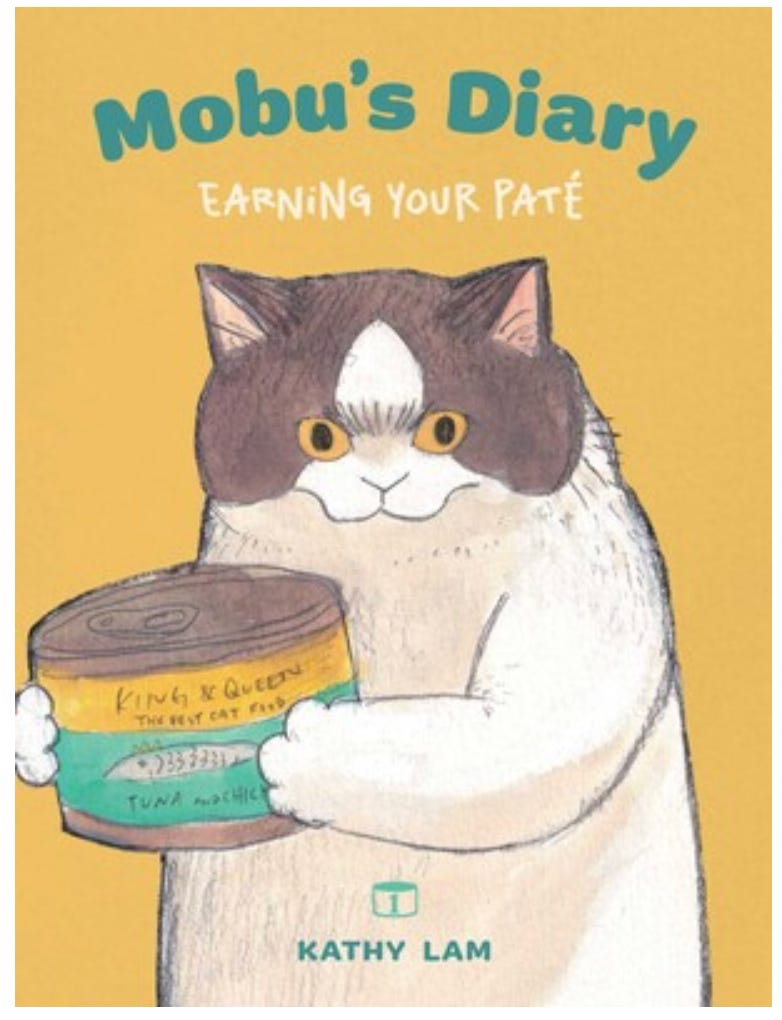
Michelle: And then Mobu’s Diary, co-translated with Cindy Ko, is dropping in bookstores. That’s exciting. Well done!
Is there anything you’re reading now that you’d recommend? Or more generally, What’s exciting you these days?
Kevin: I’ve been dedicating more time to writing poetry lately. It’s nice to put on a freestyle rap beat and lock into a lyrical and confessional mode.
I’ve also been having some breakthroughs in re-thinking my teaching. I designed an “unessay” final project for Cultural Studies, where students make an artifact that reinterprets or adapts a cultural text and they write an artist statement where they include a process note and show their understanding of the course learning objectives.
My class on sustainability has also become more hands-on. I’m learning from students what experiences are most engaging and meaningful to them. We tried re-purposhing trash. They looked at the tags on their clothes and researched the brands’ sourcing practices vs. their marketing. We’re going on field trips to different parts of campus, then reporting on accessible vs. exclusionary architecture.
These two courses were dropped into my lap a few months ago. I felt helpless at first but now I’m really excited about them.
Michelle: Could you talk a little bit about the worlds and communities that you’re a part of in Taiwan?
Kevin: I’ve made precious friends from regularly going to Taipei Poetry Collective workshops, the weekly meetings of the Writing in Taipei group (we recently had some amazing board game nights), New Bloom events—we’ve just had some new co-hosts join the volunteer team that runs Stories of Taiwan reading club. I’d also hang out with people from the Fulbright or translation community, though they tend to move around a bit more. I love spontaneously messaging a friend after work and getting dinner together.
Michelle: Do you see yourself staying in Taiwan? Is returning to the U.S. (or China!) something you want?
Kevin: That would depend on what a partner wants or how my parents are doing. For now, I have no plans to leave. I recently did a writing exercise where you first write out how life would unfold in five years if you stay where you are and stick to your current direction, and then how life would unfold in a world where money, prestige, and the opinions of others don’t matter. It turns out these two visions look really similar, and my commitments here are already aligned with my most important values. Being far away from family is the one downside.
Michelle: What do you most wish for during your time here?
Kevin: I hope I can give back to my community. I want to throw a fruit themed party. Bring fruits, be dressed as fruits, play fruit games.
I want to have more little chats with strangers. They are always so funny and generous. I feel shy on some days and close myself off to that possibility.
This morning I thought, what if I proposed a course to my department on witchcraft. Students can learn about witchcraft in the cultural imagination and make a zine of spells that they invent. But what if that’s irresponsible, since I’m not yet properly trained? Maybe I’d just focus on the literary aspect of witches, and sneak in attempts at praxis once in a while.
Michelle: How has your relationship to Taiwan changed over the years?
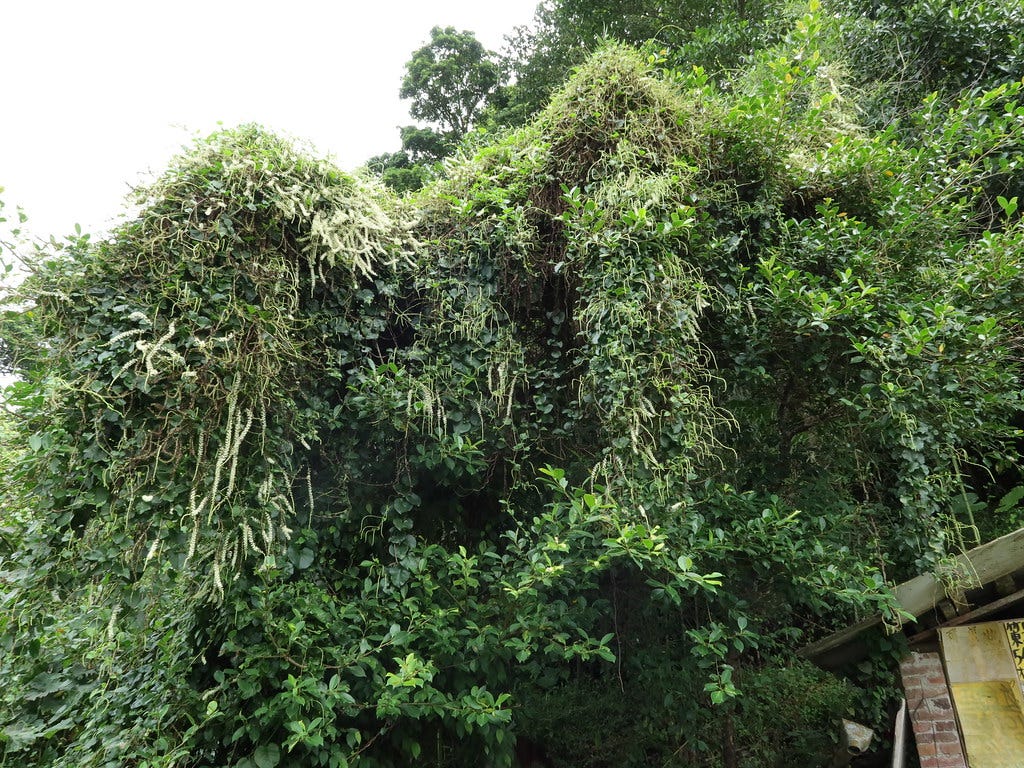
Taiwan is teeming with abundance. Even the way it smells: always so sweet with flowers, or earthy, not to mention the food.
My friend Brandon and I ventured out to the Shibafen Canal Trail somewhere between Tianmu and Beitou two days ago. He showed me the edible plants like Madeira leaves and tubers (川七)—we collected a bunch and I stir fried them. A farmer on the side of the road even gave us some waxberries.
Taiwan has made me more myself. It’s an environment where I can grow into the kind of person I want to become. And the people I’ve met here have taught me so much and helped me along that journey. I lived in New York for five years before this, and I appreciate that energy too, but I feel that in New York, unless you’re uber rich, you have to be pretty scrappy to survive and scheming for the next gig and competing to be interesting. I think I like living in a place where it’s enough to be kind.
Book Club: Half A Life
We loved talking to you all about Niall Williams’s This is Happiness!
Our next book club is on May 29th (Friday 7 PM EST). We’ll read Darin Strauss’s Half a Life; and, on June 26th (Friday 7 PM EST), we’ll read Omar El Akkad’s One Day, Everyone Will Have Always Been Against This. After that, we’re reading Diana Athill’s Stet, Ferrante’s My Brilliant Friend, Kiran Desai’s The Loneliness of Sonia and Sunny, Anuk Arudpragasam’s A Passage North, Arundhati Roy’s Mother Mary Comes to Me, Ana Paula Maia’s On Earth As It Is Beneath (translated by Padma Viswanathan). Thanks to our book club members for their suggestions! Please reply to this email for a zoom link if you’d like to join.