When Men Kill
ICE terror in the U.S. and a violent stabbing in Taipei; plus a discussion with author Grace Loh Prasad at Bookman Books on Tuesday (tomorrow) at 19:30

Hello dear readers,
We apologize for being out of touch. Partly it’s the continuation of the end-of-year crush that always feels so intense in Taiwan. (We’ve had mountains of work, as well as visitors in town amid our non-Western work schedule.) But we’ve felt agitated and sickened by the news, which is awful and relentless—Maduro’s abduction, the killings of thousands of protesters in Iran, and ICE’s murder of Renee Good and terrorizing of Minneapolis. We feel fury at the authoritarian lawlessness of ICE. And now the senseless, self-destructive grab at Greenland will destroy a 75-year-old alliance with NATO. Looming over us is the sense that the more violent, isolationist, and authoritarian the U.S. becomes, the more China will feel empowered to invade Taiwan; most recently, China simulated a blockade with live-fire missiles.
This piece by Damon Linker—titled “ICE is Imposing Autocracy in Minnesota”—captures our dread and uncertainty. He admits that he doesn’t yet see a way out of our political situation. But he does have a simple and correct point: we have to keep documenting the horror in its particulars, and we can’t look away. Linker builds upon a powerful piece from January 11 by Noah Smith, which marshalled in devastating ways the evidence of ICE abuse: videos of agents arresting U.S. citizens in a Target, brandishing guns at protesters, arresting a pastor who objected to what he saw, beating and threatening bystanders, and dragging a disabled woman from her car. Writing a week later, Linker adds to the documentary evidence: flash-bang grenades used against protesters and reporters; agents going door-to-door asking residents to identify the ethnicities of their neighbors; white nationalist memes appearing on official government accounts; and a Justice Department criminal investigation of Minneapolis Mayor Jacob Frey and Governor Tim Walz for condemning ICE activity.
Linker received this email from a St. Paul public school worker:
They are swarming our neighborhoods in unmarked cars; pulling people over at random; arresting and detaining people with no warrants or cause or justification other than being brown or black; intimidating people with assault weapons in their cars, at the local Target, and at nearly every immigrant-owned business; bashing out people’s windows after traffic stops and dragging them out of their cars; knocking on doors indiscriminately and asking people for documents or to turn on their neighbors... Students of mine crying in my room because they’re scared to come to school. Students not showing up in the first place. Coming to work at a school every day where parents need to surround the premises in case they need to document a student or staff member being assaulted by a paramilitary force and whisked away to a detention center that our elected officials are not allowed to visit.
Our friend Fionnuala Ni Aolain, whom we met when she came to Taiwan earlier last year and teaches at the University of Minnesota Law School, has served as the Special Rapporteur for the United Nations. She describes the erosion of the rule of law:
I have spent over two decades working at the University of Minnesota Law School and living in and out of America. I do not recognize this country now... Watching the violence, unconstitutionality, coercion, intimidation, grim racism, and terror produced and sought by ICE agents in the State of Minnesota reminds me of countries I have visited as a UN Human Rights expert where there was no pretense of rule of law, no control, a celebration of repression, no limitations, and where political leaders consistently found ways to justify violence against those who disagree with them, those they view as “other.” Terror is the point in Minnesota for the Trump administration, violence is the point, dehumanizing black and brown people is the point.

Still, stories of mutual aid in Minneapolis—and growing popular support for abolishing ICE—give us hope. Peter Birkenhead writes:
There are single moms standing at their kitchen counters in Minneapolis right now, making 35 or 40 sandwiches to drive across town and distribute to people who can’t leave their homes for fear of being beaten and abducted. I don’t think they need to hear from you why nothing will work and ICE can’t be stopped and Donald Trump is a wizard with a magic wand that can make federal court injunctions and midterm elections disappear.
As another person shares in Un-Diplomatic:
The real resistance is invisible, in the form of dozens of encrypted group chats that are coordinating food deliveries to families who can’t leave their houses. That invisible stuff is also very mainstream and happening in non-activist circles. [...] The complexity of the mutual aid networks here is astounding. Beyond any anarchist theorist’s dreams. Like we’ve seen in other cities.
If any of you have ideas how we can help from afar, please let us know. Thanks to Eileen Chow for sharing a thread about how educators can help by giving guest lessons for courses at K-12 and universities that have gone online. There’s good local reporting at Sahan Journal (h/t/ Undiplomatic), and a sourced listing of documented ICE abuses in Minnesota (h/t Susan at Kalamazoo Visibility Brigade).
In Taiwan, we’ve also felt discombobulated by the dizzying news: a record $11.1 billion U.S. arms sales; China’s retaliatory “Justice Mission 2025” exercises simulating a blockade with live-fire missiles landing closer to Taiwan than ever before; a separate exercise of “staggering” proportions in which “thousands of Chinese fishing boats act[] in concert” and form sea barriers that block access to Taiwan; a Constitutional Court ruling that reactivated a judiciary that had been paralyzed for a year; the impeachment proceedings launched against President Lai; an ongoing budget deadlock that has frozen defense spending and forced last-minute workarounds for transit subsidies; and finally, a tariff deal with Washington trading $250 billion in semiconductor investment for a 15% cap on duties—which Premier Cho called “the best tariff deal” among U.S. trading partners, and which Beijing promptly condemned.
But perhaps the biggest news of December was a knife attack in Taipei’s metro system on December 19th. A 27-year-old man set off smoke bombs during evening rush hour at Taipei Main Station, the main transit hub of the city. He then moved to Zhongshan Station, a popular shopping area, where people were out buying gifts for Christmas. He killed three people, injured several others, and later died after falling from a nearby building as police closed in. One of the victims, a 57 year-old man named Yu Chia-chang (余家昶), died trying to prevent him from causing more damage. On January 13, the Taipei city government erected a memorial plaque to honor him.

The attack was shocking on multiple levels. For one, violent spectacular crime is rare in Taiwan. But perhaps most disconcerting was the way surveillance footage showed the perpetrator moving through the station with eerie calm and composure, clearly performing for the camera—as if he knew that his actions would go viral. Subsequent investigation revealed he had been preparing meticulously for over a year.
The public conversation that followed revealed a bit about the current state of Taiwanese society and politics. People in the media debated how to refer to the event. Was it terrorism (恐攻)? Or should it be called an “indiscriminate attack” (無差別攻擊事件), a term that emphasizes the randomness of the violence without the political connotations of terrorism? According to Taiwan’s National Police Agency definition, “terrorism” refers to acts by individuals or organizations driven by political, religious, racial, or ideological beliefs intended to instill public fear. No previous random killing in Taiwan has ever been classified as such. Arguments about the label continued: terrorism implies ideology, organization, a cause—whereas “indiscriminate attack” suggests something closer to nihilistic violence, a lone actor lashing out at strangers for reasons that may be personal, psychological, or unknowable.
Then there was the question of whether to release the suspect’s name. Since mass stabbings are so rare in Taiwan, some argued that publicizing it risked inspiring copycats; notoriety incentivizes alienated young men. Some Taiwanese politicians, such as the Taipei city councilor Miao Poya, referenced the the American “No Notoriety” movement as well as former New Zealand Prime Minister Jacinda Ardern’s words after the Christchurch mosque shooting: “I implore you: speak the names of those who were lost rather than the name of the man who took them. He sought notoriety—but we in New Zealand will give him nothing, not even his name.” Others made the case that we need to know more to get to the root cause of the violence; without understanding who did this and why, how can society address whatever conditions produced him? Psychiatrist Lee Chun-hung cautioned against premature simplification, noting that such violence typically emerges from accumulated “life-course risk trajectories”—high-risk family backgrounds, severed social support, weak intimate relationships, educational disruption, social marginalization—rather than any single psychological state.
People also have sought to situate the killings in relation to a global rise in nihilistic violence. Commentators noted that mass transit systems worldwide have become targets for such violence, their dense crowds and enclosed spaces offering the combination of vulnerability and spectacle that perpetrators seek. The timing invited global comparisons: the Taipei stabbing of mass-casualty attacks elsewhere—among them the car-ramming at a Christmas market in Magdeburg, Germany, the New Year’s Day truck attack in New Orleans, and, in China more than twenty mass-casualty incidents, including the Zhuhai car-ramming that killed 38. Was Taiwan now part of a global pattern? Criminologist Tai Shen-feng suggested that this killing marks a turning point: unlike the 2014 MRT stabbing case (modeled after the 2008 Akihabara massacre in Tokyo) or the 2024 Taichung MRT stabbing (a copycat of 2014), this violent act showed fewer “imitation” elements and increasing sophistication.

Others immediately saw the domestic political implications, questioning the lack of “resilience” in Taiwanese society. “Resilience” has been a keyword for the Lai administration, which recently distributed to every household an “orange book,” a civil defense handbook that offers guidelines in the event of an invasion or natural disaster. The bystander footage became evidence of a broader unpreparedness—a population unsure how to respond when confronted with sudden violence. Nearby bystanders initially thought the attack was a drill; it took an alert Starbucks employee to realize it was real, closing the shop’s gate to prevent further harm. Critics noted that despite the suspect’s bizarre attire—full tactical gear, gas mask—he lingered in the metro station for 35 minutes without anyone questioning him. Some framed this as a matter of disaster preparedness: commentators observed that mass transit systems test not just police and city governance but public emergency response capabilities. If people froze during a knife attack, what would happen during an earthquake, a typhoon, or an invasion? (Still, Taiwanese on the whole know what to do for earthquakes and typhoons, and violence is rare enough that people can hardly be faulted for not knowing what to do.)
And of course, a lot of this talk moved further in the direction of conspiratorial thinking. In the immediate wake of the stabbings, speculation swirled on PTT, Threads, and other social media platforms about whether this was the work of a fifth column. The gear and the methods of attack—smoke grenades, tactical armor, the meticulous planning—fed rampant speculation: could this person really be acting alone? Some framed the incident as a “stress test” tied to urban warfare tactics, a probe by Beijing to gauge Taiwan’s responses. Rumors also circulated that the perpetrator’s mother was a Chinese spouse. The National Security Bureau deputy director was even questioned in the Legislative Yuan. The speculation grew so intense that Interior Minister Liu Shih-fang felt compelled to respond publicly, stating that after assessment there was little connection to foreign forces and urging people to cease circulating online rumors.
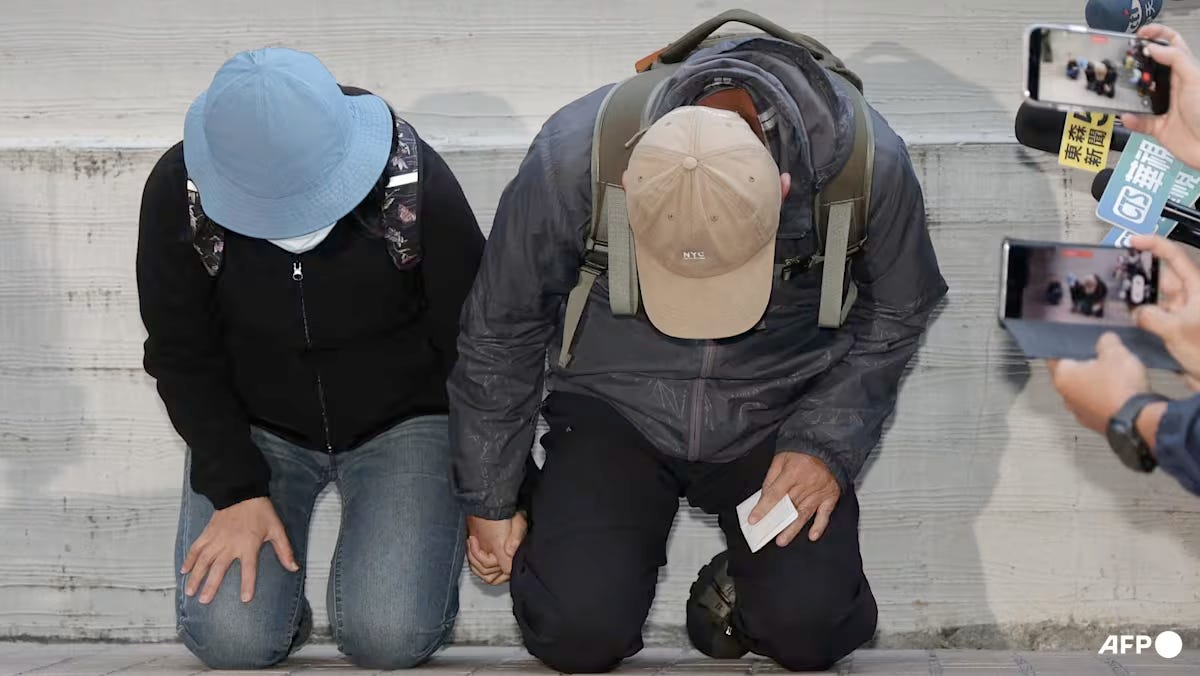
The photo of the perpetrator’s parents bowing in shame moved us. Four days after the rampage, the parents appeared outside the funeral parlor where an autopsy of one of the victims had just been performed. Wearing hats and face masks, declining to give their names, they knelt before television cameras and bowed three times. “The heinous crimes that our son committed brought harm to society,” his father said, “and inflicted irreparable harm and pain to the families of the victims.”

The gesture has become a grim tradition since 2014, when a 21-year-old young man stabbed passengers on a Taipei Metro train, killing four. Six days later, the man’s parents publicly apologized at Jiangzicui Station—the very station where their son had been arrested—kneeling and weeping before reporters. His father called for a swift death sentence, saying the crime was “unforgivable.” (His son was convicted and executed in 2016.) The families of the 2014 victims refused to accept the apology. Several victims’ family members heaped further scorn on the parents, saying that the parents “did not teach him well and he eventually became society’s problem. Society has paid a great price for his deed.”
Twelve years later, the conversation has shifted drastically. Some people have openly questioned whether such gestures are necessary. One of the boldest voices in the debate is the legislator Claire Wan-yu Wang (王婉諭), whose daughter was murdered in a random attack in 2016. In a thoughtful interview with the journalist Chifei Fan, Wang said she didn’t personally expect the killer’s parents to apologize—even though she understood why the public wanted them to. She called for a deeper look at the wider social factors that contributed to violence, instead of focusing on the offender’s individual or familial responsibility.
The attack has ignited nationwide debate over parental responsibility when adult children commit violent crimes. The mother of Yu Chia-chang—the hero who died to prevent more harm—urged the public not to blame the perpetrator’s parents. “As an adult, he bore sole responsibility for his actions,” she said. Investigation has shown he had been estranged from his family for over two years, and had planned the attack for months without their knowledge.
Compared with earlier incidents, public discussion has shifted away from shaming parents and towards the need for better social services. Some may argue that had the attacker survived, the discourse would have included calls for the death penalty. But we believe the emergence of these voices signals a shift toward a less punitive public discourse—one that is willing to confront society’s collective failures instead of heaping punishment on a single family.
We don’t want to overstate our case, but we suspect this new empathy within a penal culture comes from the shared experience in Taiwan and more broadly the world we live in now: peering into the abyss that is the Internet. Who among us has escaped its addictive and powerful algorithms? Dread, loneliness, despair, helplessness—we’ve all touched these emotions while scrolling. Every person we know, including in our own family, has at least one member radicalized by it. More, as parents of a six-year-old who has discovered Youtube, we already feel that parts of her have become mysterious and unfathomable. What terror parents must feel in the face of such ubiquitous and unstoppable forces, these parasites and echo chambers that drive us away from each other, from tangible connection and real communication.
Haunting, too, was the discovery that the perpetrator had been obsessed with the 2014 stabbings. Police found search records on his tablet going back to 2024, along with notes expressing sympathy for the 2014 attacker—including comments like “Taiwanese owe justice to [name of the perpetrator].”

We keep wondering: who bears responsibility when men kill?
In Minneapolis, nobody takes responsibility. Within hours after an ICE officer murders Renee Good through her windshield, Homeland Security Secretary Kristi Noem declares the shooting justified. Vice President J. D. Vance praises the agent, Jonathan Ross, as someone who “deserves a debt of gratitude.” The president says Good had “viciously run over” an agent—a claim contradicted by video. A fundraiser for Ross, as of this date, has garnered over $779,000. The Justice Department opens an investigation—into Good’s widow, to determine her ties to activist groups. Six federal prosecutors in Minnesota resign in protest.
No one kneels. No one bows. No one on the side representing violence asks forgiveness from the family of the woman who was killed.
Are there any connections between these incidents? Probably not; we just feel intensely the dissonance of observing and reacting to these violent acts in the span of a couple of weeks.
Several weeks on, we still can’t shake the image of the two parents bowing. The depth of their bow. Their shame. Their willingness to prostrate themselves. In this gesture they absorb the bloodlust and grief of others. They will not say a word. They will eat their own grief—they lost a child, too. Likely they fear that if they speak, they will be mistaken as defending or rationalizing what happened. They fear disrespecting the victims. So they don’t talk at all. They bear sole responsibility even though so many social forces were at play: the internet, loneliness, schooling, atomization, and yes, the crisis of masculinity.
But they’re holding hands. In this small act, they suggest their will to self-annihilation is not total. For two people who must feel they have gone to hell, who must be wondering what they could’ve done to prevent such horror, these interlocked hands insist on their right to warmth, to touch, to the world of the living.
In Conversation with Grace Loh Prasad at Bookman Books
This coming Tuesday night (January 20th, 19:30 Taiwan time) Michelle is in conversation with Grace Loh Prasad’s The Translator’s Daughter at Bookman Books. We would love to see you there! Grace’s book is a soulful meditation on family, diaspora, and grief, and the conversation will be in both English and Mandarin, with the formidable Su Shin as our interpreter.
Some Links
We didn’t write about the Maduro abduction, but if you are interested in a quick primer about the history of what’s going on, we recommend this episode of the Search Engine podcast and this article by Alejandro Velasco, “The Many Faces of Chavismo.” This episode with Greg Grandin for the American Prestige podcast was also great. And on that similar note, since we came back from Mexico, we’ve been reading Grandin’s America, América, which is amazing.
We also recommend this conversation between Ross Douthat (OK, not our favorite, but the conversation is good) and Francisco Segovia, the executive director of Communities Organizing Power and Action for Latinos (COPAL), which is at the front lines of anti-ICE activism in Minnesota.
Thanks Vickie Wang for her terrific collection of English-language sources on Taiwan and her kind shout-out to our newsletter.
An old piece we wrote about violence, crime, and penal culture in Taiwan.
Book Club: Percival Everett’s James
It was wonderful to talk to our book club about Budi Darma’s book People from Bloomington (tr. Tiffany Tsao). On March 6th / 7th (Friday, 7 PM EST), we’ll read Percival Everett’s James. On April 24th / 25th (Friday, 7 PM EST / Saturday, 7 AM Taiwan time), we’ll read Niall Williams’s This is Happiness. On May 29th (Friday 7 PM EST), Darin Strauss’s Half a Life; and, on June 26th (Friday 7 PM EST), we’ll read Omar El Akkad’s One Day, Everyone Will Have Always Been Against This. After that, we’re reading Diana Athill’s Stet, Ferrante’s My Brilliant Friend, and Kiran Desai’s The Loneliness of Sonia and Sunny. Thanks to our book club members for their suggestions! Please reply to this email for a zoom link.
Michelle’s childhood friend Susan has been organizing a visibility brigade in their hometown Kalamazoo, Michigan. Thanks, Susan, and everyone who has kept hope alive.


The videos of the parents kneeling broke my heart. I feel so much sympathy for them. As you say, as our children grow they become ever more foreign and mysterious to us, and yet I'm sure no matter what, I will feel responsibility for who he becomes, will wonder if I could have done better somewhere. I cannot imagine what these parents feel - the shame, the guilt, but also a private grief that they've lost their child, a grief that they can't express publicly. To not be able to mourn your child. No matter who he became, I'm sure they still remember the little boy he was. Of course what he did was reprehensible. But it is strange to me that somehow in Taiwan culture this is the thing that happens. Does it make anyone feel better? It's good to know that it does seem like a shift is happening now though (also I hadn't realized that the mom of the little girl who was killed in 2016 is a politician! I will never forget her sobbing face on tv, her appeals not to simplify this narrative into just making it about how crazy people should be locked up and how she didn't seek death penalty. It was only a few months after I moved here and it was such a shocking thing to see happen, and see the different views expressed.)
Conversely, I feel like people could take a little *more* responsibility in the West, but there's just always so much blame deflecting.
I don't know, all of it, it really sickens me.
I teared up reading about the parents. Thank you for this ❤️